

I’d Like to Ask Jeeves
missed the window to quit while ahead, so these are my options now...

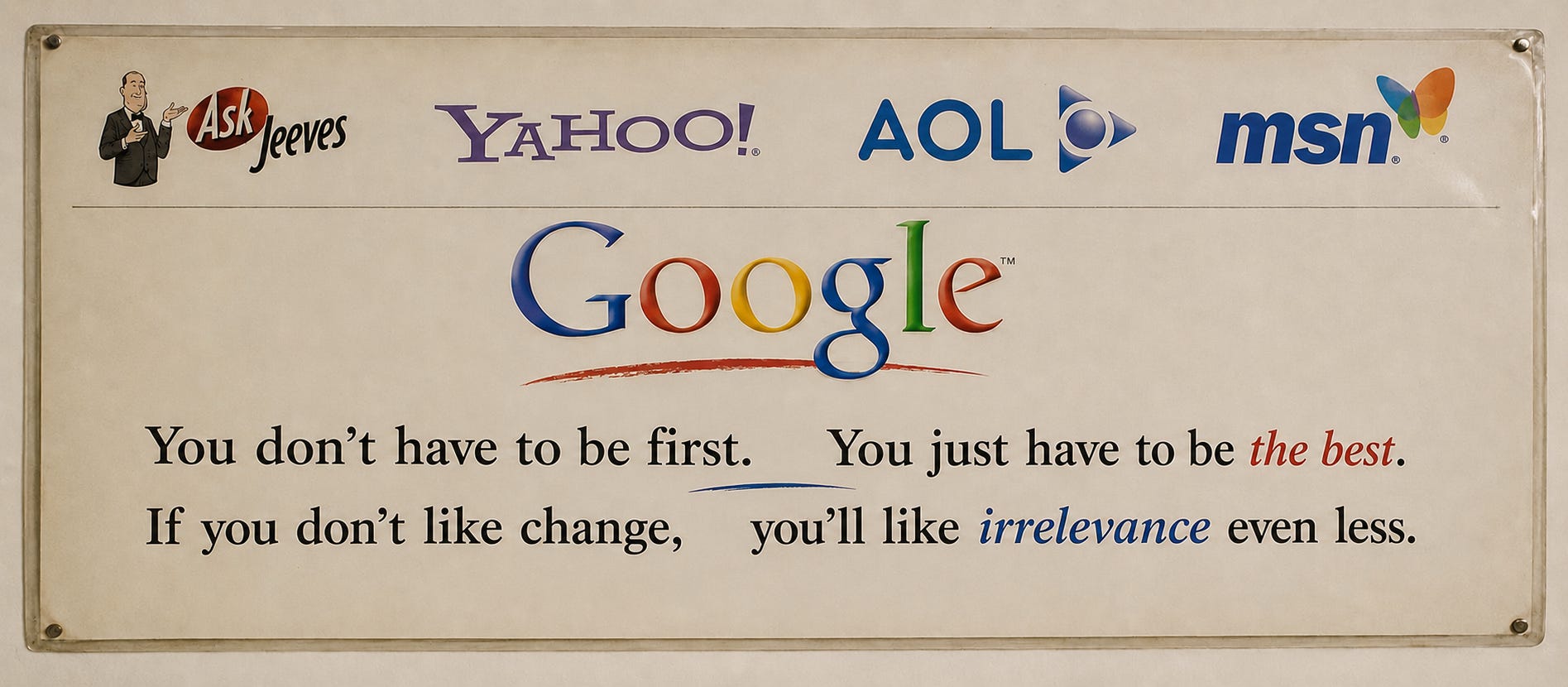
In college, my guidance counselor’s office had posters on the wall, most of them looked like they were mass-produced for every career center or HR office, inspirational font, sunset, laminated. But one of them has stayed with me. Across the top were the logos for Ask Jeeves, Yahoo, AOL, and MSN. Beneath them sat a single colorful Google logo and a caption that read: “You don’t have to be the first. You just have to be the best. If you dislike change, you’ll like irrelevance even less.”
I glanced at it once, half-listening to my counselor talk about internships. Back then reinvention was so distant I couldn’t even conceptualize it. I was still inventing myself. Turns out, all these years later, it was waiting in the back of my mind. Now I relate to Jeeves.
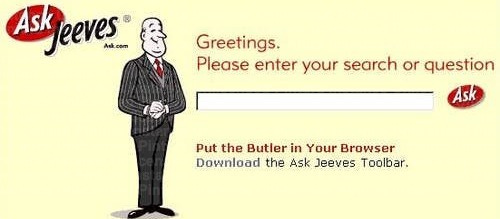
Jeeves Was Too Prompt
Jeeves had a catchy logo, funny ads, and a concept that was genuinely novel: a search engine that acted as your personal butler, not a list of links, but full sentence answers, a conversation.
Then a few years in, the technology evolved and competition accelerated. So Jeeves tried to pivot from a question-and-answer platform to a straight search engine—giving up the very thing that made it unique. This meant competing directly with Google, and Jeeves entered that race at walking speed while Google was already sprinting. It was too late to change, and too late not to.
What if Jeeves had doubled down instead? Leaned into his uniqueness rather than adapting to fit the market. At a time when searching meant typing “grocery store near me open,” Jeeves was selling something weirder and more human. It taught users to speak in full sentences, receive full answers, and treat the search engine like a butler with the entire internet as his brain.
Back then this sounded like a Jetsons episode. Now it sounds like a Tuesday afternoon on your phone.
Maybe Jeeves was just early. Maybe, had he stayed the course, he’d be ahead of not only Google, but Claude, too.
You can be early and still lose. So much of life is timing. Nearly twenty years later, Google now understands how Jeeves and the other logos on that poster felt.
And so do I.
Too Old to Die Young
Chris Black often jokes that the best thing a musician can do for their career is die.
No breakup tour. No Vegas residency. Frozen at their peak. Nirvana is forever cool.
If you disappear early, you never have to make something mediocre after something great. You never have to age into a version of yourself that doesn’t quite match the myth.
But if we keep living, then what?
It’s embarrassing to still be alive. To be seen still trying, with less momentum, less mystery, and a more accurate sense of your own limitations than you had the first time around.
By no means had I reached any high metric of success, but like Jeeves, I was an early adopter. In 2013, I was ahead of the wellness and podcasting waves, and I knew it, a little. I had enough traction early on to give me delusional optimism, but beginner’s luck expires.
One day I looked up and the internet had moved on. I felt like my podcast logo could’ve been in the top row of a poster in a career center somewhere.
I never felt ahead, but looking back, there was a peak. I missed my window to quit while ahead. So now my options are: irrelevance or a comeback.
I dislike change, but I like irrelevance even less, so evolve it is…
I agree disappearing is certainly the coolest career move. But after aging out, I wanted examples of an alternative. People who evolved. So I turned to Yasi Salek , something of a post-cool expert whose work has made her a scholar of artists’ late-career output.
After examining hundreds of cult bands’ and iconic artists’ full discographies on her podcast, she’s found that no matter how brilliant a band was in its prime, 90% of late-career output is, as she puts it, “at best... tepid trash. At worst... so humiliating it’s almost legacy-erasing.“
But there are exceptions. These later releases hold complexities that could only come with time. Yasi sees them as the product of profound maturation and endurance. When youthful angst matures into reflection, she’s found, it can produce an artist’s most spiritually rich work.
Discussing Death Cab’s new album, she said:
I study late-period releases, and obviously they can go many ways, but this is kind of the perfect balance of making something innovative while still keeping the core elements you love about them.
Yasi introduced me to a new possibility: evolution not as abandoning your core identity, but as inhabiting it more fully, a framework I want to try to apply in my own work.
Not Working = Not Evolving
I never thought I’d still be doing the same internet things I began on my MacBook during college lectures. But I am. The tools changed, the technology shifted, but my impulse to share what I’m learning and inspired by in somewhat real time has remained. I’m in the process of evolving that into its next phase, slowly.
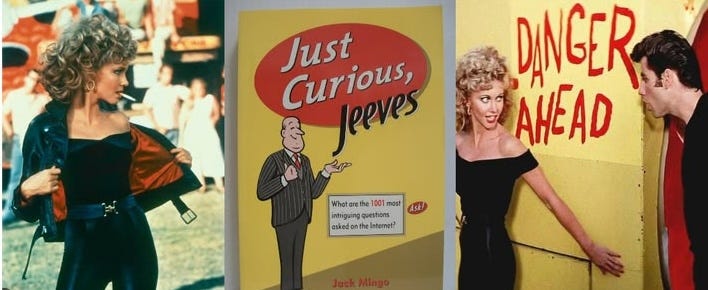
I wish I could do it more privately. Disappear for the summer and come back unrecognizable, like Sandy at the end of Grease.
A Sandy-D reveal is much cooler than being seen while fumbling and experimenting my way through an evolution in real time. Growing up, trying felt deeply uncool. Even now, visible effort makes me uncomfortable, especially doing it again, older, in front of people who remember the earlier, more successful version.


Compost > Phoenix
I used to think reinvention required burning everything down, and now I think it’s just trying harder at what I was already doing but too ashamed to show.
And instead of starting fresh, what if I kept the original ideas and just update how I deliver them?
It’s easier to assume the idea was the problem. The harder truth: I had an execution problem.
Last year, I finally asked myself: is my work not working? Or am I not working on it?
I avoided updating what I had by taking the opportunities that fell into my lap—collaborations, projects, side jobs. None of them fit. They were all ways of avoiding the shame of self-promotion and evolving in public.
If I could rewrite that poster, I wouldn’t say “You don’t have to be first. You just have to be the best.”
I’d say:
You don’t have to be first. Or the best. You just have to keep going—even when you are behind.
Because as long as you’re still here, willing to look foolish, you can come back. Not as a return. As something new.
Maybe relevance isn’t about staying ahead. Maybe it’s about staying long enough. Or maybe it’s letting yourself fall behind, feeling the sting of it, and using that as fuel when the delusional ambition of youth has run out.
I don’t know. I could be wrong. I’d like to ask Jeeves.
In fact, I have a bunch I’d love to ask.
He isn’t available. He doesn’t have to wait on any of us anymore. He’s free from this robot revolution.
I heard he took that dot-com money and has been living on an island somewhere, probably painting, maybe running a wine bar in Spain. Knowing him, he made the most of his retirement.
He earned it.
love,
kd
p.s.
The COMEBACKS series is live: conversations with people stayed long enough to come back. Listen wherever you listen, apple, spotify, youtube.
Shownotes: www.letitouttt.com
Also, if you aren’t already a fan of my favorite podcast, Bandsplain—it’s time. And if you’re not already reading Fast & Loose get yourself subscribed.


KEEP IN TOUCH

While it would be lovely to disappear and come back all changed like Sandy, what always bugged me about Grease is the way Sandy changes to fit in with everyone else, almost bit like AskJeeves did… I’d have preferred her to “lean into her uniqueness.” That certainly would have been a better role model for my teenage self.
Interesting post - a great way to start my morning.
This came at the perfect time! And as a long time listener and reader, I can’t wait to hear/see what you do next!🥰